Free UK Wagering Requirements Calculator: How to Use It
Four sliders turn a bonus and its wagering multiple into the stakes you would have to place and what playing through is expected to cost. This page explains each result and where the arithmetic stops.

Behind the bonus
What do the numbers really mean?
Move the sliders or type your own figures to see the turnover a bonus asks for, based on common bonus terms.
The wagering ceiling for bonus funds in the UK is 10x. Game contribution is the share of each stake that counts towards the requirement; check the offer's terms for the real share. The cost line is arithmetic on an assumed 96% return, not a forecast.
Bonus breakdown
£100 × 10
£1,000
Required turnover
- Stakes neededat 100% game contribution
- £1,000
- Per dayan even split over 30 days, not a target to play
- £33.33
- Illustrative costassumes a 96% return, not a prediction
- £40
Illustration, not a predicted outcome.
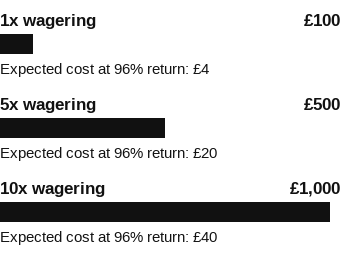
The slider you will reach for first is the multiple, and it stops at 10x. That is on purpose. Every other figure on the calculator above hangs off that number, so it helps to know what it does before you drag anything.
This wagering requirements calculator takes four inputs and returns four results. As a casino bonus calculator it is plain: tell it the size of the bonus, the multiple, the days you have and the share of each stake that counts, and it does the sums. It does not look up an offer. The register above lists offers, while this tool holds arithmetic only, so you can set it to a bonus the register has never carried.
How to use the free wagering requirements calculator
Start with the bonus amount, which is the first step of how to use the sliders. The slider runs from £10 to £250. Set it to what you would actually be given, not the headline ceiling. Casumo’s 50% up to £100, Videoslots’ 100% up to £50 and Hippodrome’s 100% up to £100 are all written as “up to” figures, and a smaller deposit means a smaller bonus.
Next comes the multiple, from 0x to 10x. Take it from the offer’s terms. The 0x position is there for comparison: it shows what a clean offer looks like, with nothing to clear.
Then days to finish, from 1 to 60. This one is yours rather than the operator’s, but the register tells you which limit to respect. The longest window on it is Videoslots’ 60 days, and the slider reaches that far. MrQ lists spins valid for 48 hours, which is why the slider starts at a single day. The page on casino bonus expiry sets out how the clocks inside one offer differ.
Last is game share, offered as 100%, 50%, 25% or 10%. Share is the portion of each stake that counts towards the requirement. At 100%, a £1 stake clears £1. At 10%, it clears 10p. Which share applies to your game is a question for that offer’s terms, and this page does not guess at it. The idea itself is explained on the game contribution page.
Treat the bonus wagering calculator as the second step. The first is reading the terms to find the three numbers it needs: the bonus you would receive, the multiple and the share for your game. A bonus wagering calculator can only be as good as the figures typed into it, and a guessed share is the usual weak point.
Reading the four results
Turnover required is the bonus multiplied by the multiple. A £40 bonus at 8x gives £320. It is the number printed in the terms, and it is the least useful of the four, because it says nothing about how much you would actually stake to reach it.
Stakes needed at this share is the one that matters. It is the turnover divided by the share, so it equals the turnover only at 100% and grows as the share falls. £320 of turnover at 25% means £1,280 of stakes. People mix the two figures up all the time, and the gap between them is where most of the surprise in bonus terms lives.
Per day over the period is the stakes divided by the days. Read it as a pace, not a target. A £100 bonus at 10x over 30 days at 100% share works out at £33.33 a day, which sounds light until you remember that the sliders assume you play on every single day until the end.
Expected cost at a 96% return is the stakes multiplied by 4%. It is the price of playing through at that illustrative return, and it gets its own section further down.
Three worked examples
Each of these can be reproduced on the sliders. The bonuses are hypothetical, chosen to show how the results move.
First, a £50 bonus at 10x, 30 days, 100% share. Turnover required is £500. Stakes needed are also £500, because the share is 100%. Per day that is £16.67, and the expected cost at 96% is £20.
Second, a £100 bonus at 10x, 30 days, 10% share. Turnover is £1,000, but stakes needed jump to £10,000. Per day that is £333.33, and the expected cost is £400.
Third, a £250 bonus at 5x, 14 days, 50% share. Turnover is £1,250, stakes needed are £2,500, the daily pace is £178.57, and the expected cost is £100.
Compare the first two. The multiple is the same and the bonus is only twice the size, yet the expected cost is twenty times higher. All of that comes from the share. The third example has the lowest multiple of the three and still costs five times more than the first, because the bonus is five times larger and only half of each stake counts.
That is the pattern worth carrying away from the sliders: the multiple gets the attention, but the share sets the bill.
Why a UK bonus wagering calculator stops at 10x
The multiple stops at 10x because that is the UK ceiling on wagering for bonus funds, set by the Gambling Commission. A UK bonus wagering calculator has no reason to offer 20x or 35x, since no offer on the register may ask for it.
The register agrees with the slider. Nine of the 19 offers show a 10x multiple, on the bonus or on spin winnings: Duelz, NY Spins, VoodooDreams, Casumo, 32Red, BetVictor, Videoslots, Hippodrome and Magical Vegas. Thirteen of the 19 have wager-free spins, though a few of those, BetVictor, Videoslots and Hippodrome among them, still put 10x on a separate bonus. For the other ten, which carry no wagering anywhere, the calculator has little to add.
An offer whose wagering is on deposit plus bonus is not on the register at all, because that base can sit above the 10x ceiling on the bonus itself. The wider rules a UK reader can rely on are set out on the UK casino bonus rules page, and the multiples in context are on the wagering requirements page.
At the far end of the sliders the worst case is £250 at 10x on a 10% share: £2,500 of turnover, £25,000 of stakes and an expected cost of £1,000. No other setting produces a bigger number, and nobody should read it as a target.
Comparing two offers with the sliders
The calculator earns its keep when you run two offers through it one after the other. Take Casumo’s 50% up to £100 at 10x and Videoslots’ 100% up to £50 at 10x, both from the register, and take the full bonus in each case. Casumo asks for £1,000 of turnover and Videoslots for £500. With a 100% share assumed for both, the stakes needed are the same as the turnover, and the expected cost at 96% is £40 for Casumo and £20 for Videoslots.
Now add the days. Casumo gives 7 days, so the pace is £142.86 a day. Videoslots gives 60 days, so the pace is £8.33 a day. Same multiple, similar shape, and the second is easier to live with by a wide margin. You do not need a wagering requirements calculator to see that the time limit is doing the work, but it puts a number on how much.
A wagering calculator will not rank offers for you, and it is not meant to. What it does is stop two offers with the same multiple from looking the same. A casino bonus calculator that shows both sets of results side by side has done its job, and the rest is a decision about how much you would have staked in any case.
What the calculator leaves out
Four things sit outside the arithmetic, and each can matter more than any slider.
The first is random results. The calculator treats every stake as returning 96p per £1, and real play does not behave that way. A balance can run out long before the turnover is reached, or grow well past the starting bonus. The tool cannot say which.
The second is maximum stake rules. Some offers cap the size of a bet while bonus funds are live. On the register that is £5 per bet at Duelz, NY Spins, 247Bet and Casumo, £15 at 32Red and £20 at Videoslots. The £10,000 of stakes in the second example would need at least 2,000 bets at a £5 cap, a count no slider shows. The detail is on the page about maximum bet with bonus funds.
The third is expiry penalties. The register records how long a bonus or a set of spins lasts, not what the operator does to the balance when the time is up. The terms say what happens, so read that line before you opt in.
The fourth is withdrawal rules and win caps. William Hill caps winnings from its Free Spins at £30, and NetBet and 247Bet record £100. The calculator does not model cashing out, so a cap can sit quietly on top of an otherwise tidy sum. Those figures are collected on the page about bonus max win and cashout limits.
One more omission is smaller, and it is left open here on purpose: whether a particular slot counts at 100% or at 10%. That depends on the offer and the game, and no slider can settle it.
Expected cost is a cost of playing through, not a forecast
The last result is the one most likely to be misread, so it deserves care. Expected cost is the stakes multiplied by 4%. If a game returned 96p for every £1 staked, then £1,000 of stakes would end up £40 lighter on average, and that £40 is the figure shown.
Notice the words “on average”. A single session is not an average. You can play through £1,000 of stakes and finish ahead, or finish a long way behind, and the calculator will have been neither right nor wrong. It never claimed to know.
The 96% return is also an illustration. It is not the return of any slot on the register, and the wagering requirements calculator does not know which slot you will pick. It is fixed so that two people entering the same numbers get the same answer, which is the whole point of a shared tool.
So the figure is best read as a price. A bonus that asks for £10,000 of stakes at a 10% share carries a price of £400, set against a bonus of £100. Seen that way the offer is easy to judge, and the judgement can come out either way depending on how much you intended to play anyway. If you would never have staked £10,000, the requirement is not a small print detail, it is the whole offer.
One side note for anyone who likes to test the sliders: drag only the share from 100% to 10% on a £100 bonus at 10x and watch the expected cost go from £40 to £400 while nothing else changes.
Questions people ask
What does a wagering requirements calculator actually calculate?
It turns four numbers into four results: the turnover the terms ask for, the stakes you would place to reach it at a given game share, the daily pace over the days you choose, and an expected cost at a 96% return. Nothing in it comes from an operator. It is arithmetic applied to whatever bonus you type in.
How do I work out wagering by hand?
Multiply the bonus by the multiple to get turnover. A £40 bonus at 8x is £320. Then divide by the share of each stake that counts, so £320 at 25% is £1,280 of stakes.
Why does the multiple stop at 10x?
The Gambling Commission caps wagering on bonus funds at 10x, so the slider ends where the UK ceiling does. Nine of the 19 offers on the register show a 10x figure, and the rest are wager-free spins.
What is game share and where do I find mine?
Game share is the part of each stake that counts towards the requirement, offered here as 100%, 50%, 25% or 10%. The figure for a particular game sits in that offer's own terms, which is the place to check before you set the slider.
Is the expected cost what I will lose?
No. It is the stakes multiplied by 4%, which is what playing through would cost on average if every stake returned 96%. A real session can finish well above or well below that, so treat it as a price tag for the requirement rather than a forecast.
Why is 96% used as the return?
It is a flat, illustrative figure, chosen so that every example can be reproduced by hand. It is not the return of any game on the register. Change it in your head to 95% or 97% and the cost moves by £10 for every £1,000 staked.
Does the calculator work for wager-free spins?
Set the multiple to 0x and turnover falls to nothing, which is what a wager-free offer asks. The calculator then has little to say, because the cost sits in the qualifying deposit and stake, not in a multiple. Thirteen of the 19 offers on the register have wager-free spins.
Can I use the days slider to plan my play?
It shows the pace the requirement implies, assuming you play on every day of the period. Use it to spot offers whose daily figure is out of reach. It is not a target to hit.
What does the calculator not include?
It leaves out random results, maximum stake rules, what happens at expiry and withdrawal rules, plus any win cap on the offer. Those sit in the terms of each offer, and the sections below point to the register's figures for them.
Does a bigger bonus always cost more?
Not in proportion. A £250 bonus at 5x on a 50% share has an expected cost of £100, while a £100 bonus at 10x on a 10% share costs £400. The share and the multiple move the figure more than the bonus does.